Showing posts with label Memory-Making. Show all posts

Thursday, January 3, 2013

Freezing Time - A New Year's List

I snuggled close to my sleeping children as firecrackers boomed and whistled around us on New Year’s Eve. Blissfully unaware of the din, they had looked so sweet and peaceful.

They say childhood is fleeting. I never felt it to be truer or more real than that moment when the new year was dawning. I marvelled at the thought of my children turning one year older. Older!

Parents all over must want time to stop or at least slow down for more joyful moments with their children. To hold their chubby fingers. To kiss the tip of their perfect chins. To nudge their tiny noses with their own big ones. To hear more one-last-question-before-I-sleep-Mama. To scratch an itchy foot.

I do. 

This photo of Little T is by my friend Chiqui Obcemea
of Delight Styling and Photography.

I can’t freeze time but I promise to do the next best thing – be with my children in ways that will make the passing of these precious years something to rejoice for. I will leave no room for regret. 

I offer here my list of things to do with my children this year. Some are new but most are things I want to do more of. I pray that we will all delight in our children's childhood.
  1. Play in the dark - flashlight is a must – inside and outside the house 
  2. Take evening family strolls and not mind when both ask to be carried on the way home 
  3. Stay in the sandbox with all kinds of creepy creatures 
  4. Bake cookies, cupcakes, and whole cakes too! 
  5. Just sit, look, and be still while they are playing in their own pretend worlds. No words needed. 
  6. Read books in the garden 
  7. Let them eat like dogs if they want to - and not cringe. How they love to slurp water from their bowls on the floor! 
  8. Pretend that dogs are not scary and not scream when one gets too near 
  9. Keep giving out flour when playing “cooking” 
  10. Read that one-last-book-please 
  11. Draw on the sidewalk with chalk 
  12. Prepare trays, water, and cups for some serious pouring games 
  13. Let them wear costumes when going out without batting an eyelash 
  14. Put on kiddie nail polish as soon as a coat comes off which is about every 2 minutes
  15. Give them showers with the garden hose - and make rainbows too!
  16. Get lost on night time adventures in the garden, calling out Oh where Oh where are my children? 
  17. Stay in the bathroom until their fingers are wrinkled and they themselves declare All done! 
  18. Care for plants beyond looking at them after the seeds have sprouted 
  19. Be my ballerina’s danseur doing the heavy lifting 
  20. Fly kites 
  21. Have breakfast, lunch, snack, or dinner picnics in the garden 
What's on your list?

Make magic!


    Wednesday, November 7, 2012

    Unwrapping Christmas

    Our hands-on approach to our children's education has given us inspiration in crafting our own family Christmas traditions that focus on the spirit of the occasion.


    A Book A Day

    I also saw around the web last year another activity that I had wanted to do – unwrapping and reading one Christmas book every day until Christmas Eve. It was already too late then to gather the appropriate titles, so I vowed to start the tradition this year. 

    I’m wrapping our books now and looking forward to cuddling nightly with my little ones as we read. The books that I’ve chosen for our family are mostly about the story and spirit of Christmas – though I’ve included some about Santa Claus too, just for fun! 

    I plan to start on the first of December. We will pile our wrapped Christmas books high and will (im)patiently wait for our night time surprise. It will be like unwrapping Christmas, one book at a time, relishing the details of the story from different angles as the much-awaited date nears.

    And these are some of our books! I will definitely be adding to our collection through the years.


    • B is for Bethlehem: A Christmas Alphabet by Isabel Wilner
    • Books by Catholic author Tomie de Paola: The Night of Las Posadas, Merry Christmas Strega Nona!, The Legend of Old Befana, The Legend of the Poinsettia, The Clown of God
    • How Many Miles to Bethlehem? by Kevin Crossley-Holland
    • Baboushka and the Three Kings by Ruth Robbins
    • The Christmas Path: A Legend of the Luminarias by Sue Wright
    • The Christmas Story by Jane Werner Watson
    • We Were There by Eve Bunting
    • The First Night by B. G. Hennessy
    • The Story of Mary by Barry Martinson
    • Silent Night (a sing along book)
    • Christmas is Coming!
    • Mary's Baby by Jane Chapman
    • The Christmas Alphabet by Robert Sabuda
    • The Stable Where Jesus Was Born by Rhonda Green
    • 'Twas The Night Before Christmas by Clement Moore - a classic!


    Many of these books are available at our shop for you to start collecting Christmas books to start a new family tradition of your own too! 


    Make magic!


    Monday, October 22, 2012

    Have You Danced With Your Child Today?

    Thank you to my friend and Shop @ The Learning Basket partner, Sanne, for this inspiring blog post about one of our shared loves: Kindermusik!


    The Energizer Bunny was craving for her Kindermusik songs the other night so I put it on for her. This time, instead of just watching her, I joined in her dancing. It was so much fun! Making memories like this, while acquiring very important life skills, make me fall in love with Kindermusik week after week after week.


    Creativity    Our blocks became rhythm sticks, her plastic pots and pans, cymbals. Are you as amazed as I am when our kids imagine and come up with the most creative ideas? These are the foundations to thinking out-of-the box and creative problem solving.


    Gross Motor Skills And Vocabulary   We swayed and rocked and swung our arms up and down. We learned about directional words (up, down, side, right, left) and keeping control of our movements. We sway when the music is slow and run when the music is fast. Child’s play? Yes! And a very fun way of developing gross motor skills (for your future athlete?) and learning new words.


    Culture   I love how Kindermusik uses music from different parts of the world. My child has been exposed to African folktales, American nursery rhymes, and traditional children’s songs from New Zealand, among others. We learn about the language, rhythm, and musical instruments from all these different countries and distinguish them from our own Philippine music, dance, and instruments.


    Listening Skills   Studies have shown that early exposure to music help promote critical listening skills, as well as language and literacy, creativity and coordination. These skills are the very foundation to learning.


    We were dancing and just being silly for about an hour and it remains to be one of my favorite memories with my toddler. Ditch the gym and dance with your child today! 


    Have fun!
    sanne

    Tuesday, June 19, 2012

    Delighting in Poetry

    I have never had the pleasure of reading poetry for pleasure. Throughout my school career, poems were just something to memorize and to recite in front of a class - "Three Little Kittens" in Grade 3, "Invictus" in high school. It was distressing more than it was pleasurable!

    As a homeschooling mama, I am always challenged to overcome old fears and prejudices, to go beyond my very comfortable comfort zone, to like what I would rather not like at all – dogs, onions, and yes, poems. 

    We have been delighting in Robert Louis Stevenson’s A Child’s Garden of Verses for more than a year now. Perhaps because we are reading for pleasure, we have indeed found pleasure in the simple rhyming verses that speak about the world of children.We have also discovered that we can make poetry come alive the same way that we do our well-loved picture books – by using it as our springboard for learning, by pretending, by delighting in it. 


    I will leave you with some beautiful words from Holly Goes Lightly about why we should instill a love of poetry in children:

    “Use poetry to teach history, science, and religion. Teach poetry to help your child express herself through words. Read poetry in order to laugh out loud. Whisper poetry to lull your child to sleep. Help your child embrace poetry for no other reason than that it is a stepping stone between the concrete world and that dreamy otherworld that is our imagination.”


    Make magic!


    Thursday, May 24, 2012

    Sand in a Box (Literally)


    Hooray for this blog post by my Shop @ The Learning Basket partner, Sanne! 
    Her tips on making your own sandbox are practical and very doable!

    ~

    The dream to build a sandbox for the Little Energizer Bunny began on her first trip to the beach at age one.  It was a pleasant surprise to see her enjoying the cool, white sand.  The serious hunt for a sandbox, however,  began a few months ago after our fun play date with Little T and Baby Boy.  

    The challenge was to build a sandbox that was low-maintenance (hello, kitty litter!) and townhouse-friendly. Impossible? Not at all!

    What You Need

    1.     A bin – Any closed bin would do, just keep in mind how many kids you have and what types of activities they enjoy.  I found this bin and knew I had a winner. 


    It is big enough for two kids to play together and portable enough to bring to lolo and lola's house.  It has a cover, making clean-up as easy as 1-2-3.  If you have bigger kids who actually want to be IN the sandbox, I saw a similar bin used by panaderos (bakers) to transport their pastries that would be perfect for that kind of play.

    2.     Sand (of course!) - We bought ours at a local garden shop for P25/ki.  For this kind of bin, you need at least three kilos of sand. 

                And, as the Little Energizer Bunny would say, that's it!


    Sand Play

    It is no surprise that sand is almost always present in schools and playgrounds.  There are tons of things you can do with your sand bin! 

    1.     Creative sensorial play – I am constantly amazed at what the Little Energizer Bunny comes up with when I just let her be during playtime.  The first time she played with her sandbox, she just asked for a plastic spoon and dug and moulded her heart away for about an hour! While playing, I also introduced the concept of textures and talked about the sand being rough, and the spoon being smooth.


    2.     I Spy – I hide an object and let my child dig for it.  This is good for object permanence and gross motor skills.  I put it up a notch higher by hiding plastic/foam letters and numbers for letter and number recognition, a pre-reading and pre-math skill.  We also use our sand box like a magic slate as we practiced writing lines and letters and drawing shapes.

    3.      Dramatic/Pretend play – We act out stories that we have read before for better comprehension.  We made tracks with a twig like Peter in “TheSnowy Day” and put “sand on my hand” like Jesse Bear (“Jesse Bear, What WillYou Wear?).  The favorite, though, is cooking “sinigang” (sour soup) sand for mommy and daddy.


    Pack-away This-away

    With a covered bin, cleaning up is as easy as, well, covering the bin.   You can even let your child help pack away, a good practical skill.  And if you have a child like mine who's a “toy butterfly”, you can just chuck the sand for another time and fill up your bin with another fun sensory material (homemade slime, anyone?).


    Have fun!
    sanne

    Friday, May 4, 2012

    Got Milk? Tie-Dye It!

    Thank you to my Shop @ The Learning Basket partner Sanne for this post! 
    Sanne works three days a week and spends the rest of her time doing fun stuff 
    like the one below with her Energizer Bunny. Let us know how this works for you!


    Got milk?


    Pour a bit of milk on a shallow plate.  


    Put in a few drops of food coloring at the sides.  


    Dip a cotton bud in dish washing soap and then dip it in the middle of the milk mixture.  Watch magic happen!


    I've been told that this is used for adult psychotherapy and read that they use this experiment for bigger kids to discuss molecules.

    My toddler enjoyed "making orange and black" with the swirling, whirling colors. 


    Have fun!
    sanne

    Tuesday, January 24, 2012

    Classic, Inexpensive, Natural Toys


    While looking for “natural” toys for Little T, I remembered the mini-palayok (clay pot) set that I had as a child. My cousin and I would actually light a fire and cook some rice in it… together with some leaves and flowers. I further traveled down memory lane and recalled a small broom I used to have, just perfect for my small hands.

    Last year, I searched for these toys from my childhood. Good quality palayok sets are hard to find in Manila and we bought our unglazed clay pots in Batangas province. Child-sized versions of the walis tambo and the walis tingting can be found in Manila market stalls. These are real brooms used to clean small spaces like the back of stoves.

    Sweeping with a walis tambo


    Little T is very pleased with her real toys.  She spends hours “cooking” in her clay pots, filling them with sand, grass blades, leaves and flowers. She sweeps the floor and is very proud that she is actually helping and doing some work. I am now looking for a child-sized dust pan as she is struggling with the regular-sized one.


    Recently, I was tempted to buy a wooden cooking set that I saw. It has a two-stove burner and an array of pots and pans. It looked great. I really wanted to buy it. Compared to the palayok set, it looked… posh. But we don’t need posh. I was looking for “natural” and the palayok is as natural as the soil it is made of. 

    Cooking with clay pots, dried coconut shells, and leaves and flowers
    The walis tambo and the walis tingting are made out of coconut leaves and tiger grass, respectively. Together with the palayok, they make inexpensive, natural, and easily available toys for our kids. 

    Make magic!
    mariel

    Monday, January 2, 2012

    Why aren't those shrimps orange?


    "Are those shrimps?", chirped Little T as I was peeling and deveining the crustaceans for a salad.


    "Yes."


    "Why aren't they orange?"


    I bit my tongue just as I was about to blurt out the answer and instead said, "Let's find out!"


    I made her wait for a little while until all the shrimps were ready to be dropped into the boiling water. As soon as Little T saw the pot, though, she excitedly declared, "The shrimps become orange when they are cooked!"


    We want to be the best parents to our children. So we read, educate ourselves, and discuss not only what we want for them but also what we want to be for them. 


    That quick exchange is an example of the kind of parents my husband and I are striving to be, parents who:


    • Seriously consider their children's questions and take the time to answer them

    • Encourage exploration and discovery by giving them the opportunity to explore and observe  instead of just giving the answer outright

    • Respect and trust their children by allowing them to think for themselves

    • Make simple and mundane details of life wondrous and magical, and dare I say educational, for their children


    As we journey through 2012, we pray for more of these moments. Moments of grace when we are able to resist from doing everything for our children, moments when we are able to just step back to let their curiosity grow, moments when we can share the wonder of shrimps turning from grey to orange.


    Make magic!

    mariel

    Thursday, November 10, 2011

    Beach in Your Backyard (or Garage)


    A recent trip to the beach reminded me of how much my children love sand. A bit afraid of the lapping waves, they happily sat on, scooped and poured the golden powder for hours.


    We don’t go to the beach all the time, but we have the beach right at home. How do we do it?


    SANDBOX     I bought our sandbox almost two years ago from the first homeschooling family I have ever met. If you don’t have the patience for garage sales though, you can always use a huge basin as your sandbox. You can also have an actual box made.


    SAND IN MY SANDBOX, OH MY, OH MY!     Sand is available in your neighborhood gardening store. You can even choose the texture that you want. Do you want a rocky or powdery beach?


    THE DEEP BLUE SEA     For the deep blue sea, sea, sea, a large tub of water will do. You can also set up an inflatable pool for some splashing fun!


    TOOLS OF THE TRADE    Bring out the bucket and various digging tools that you’re saving for the beach and let the kids at it!


    MAT     Keep your space clean with a large sack, collapsed boxes, or an old tablecloth. This way, your garden or garage remains sand-free and you can just pour the precious grains back to the box at the end of playtime.


    Remember to cover your sandbox to keep animals from using it as their potty! Have fun at the beach, right at your backyard.


    Make magic!
    mariel

    Tuesday, September 20, 2011

    Raindrops and Raincoats

    Little T loves the rain. So we got her a raincoat and let her play in the rain. 


    Sometimes, she brings her umbrella.


    Make magic!
    mariel

    Thursday, September 8, 2011

    Watching Nature Unfold In A Pot

    As part of our Carrot Seed activities in which  we made the color orange, we planted several monggo or mung bean seeds. We put the seeds in a small pot and watched as the seeds sprouted and grew - fast.


    Five days after we planted the seeds, we already had some healthy leaves and were able to transfer the plant to the ground. Planting is a simple project that demonstrates the beauty and magic in nature. Everyday, we excitedly visit our monggo plant and watch nature unfold before our eyes.


    This is why I love homeschooling and Before Five in a Row. My daughter learns gently and naturally - as I do. Several months back, we read Jesse Bear, What Will You Wear. We planted sunflower seeds and marveled at the flower that bloomed after two months of waiting.


    A pot, some seeds, and a healthy dose of wonder can go a long way in teaching children about the world.

    Make magic!

    mariel

    Tuesday, August 23, 2011

    The Gift of Orange: Discovering Secondary Colors


    I taught my daughter most of the colors at 18 months. We even have a video of her handing me crayons as I called out the colors: red, blue, green, purple, orange, yellow, brown, black, even gold. I cringe now at the thought of myself as the overeager and excited mama, daring to teach such a young babe when I should have just been guiding her as she discovers the world for herself.

    As we get warmed up with our decision to keep our children at home at least for their preschool years, I learn to relax and let my daughter do what children do best: play, explore, and discover.


    Red and Yellow Make Orange

    For our most recent Painting Day for The Carrot Seed, we again tried our hand on Wet-on-Wet Painting. I limited our watercolors to red and yellow and let Little T paint as she pleased, without any expectations of form. I then sat back, kept quiet, and enjoyed the moment when she gasped Orange! I made orange, Mama!”

    It may seem strange to have just two colors out when all colors imaginable are easily available. Why mix at all? But the joy of discovering orange is a gift to any child. You can read books about mixing colors and even memorize the color wheel, but creating your own color and seeing it with your own eyes is just magical.


    As parents, we want to see our children acquire knowledge, know their colors, the earlier the better. But sometimes, seeing the wonder in their eyes and hearing their gasps of amazement as they stumble upon a new discovery is better than knowing all the colors in the crayon box, even gold.


    Make magic!
    mariel


    Tuesday, July 5, 2011

    From One Pretend Ballerina to Another: Ballet Fun at Home


    What do you do when your little girl catches the ballet bug and starts gliding, twirling, and standing en pointe anytime and anywhere? When she insists to be in her pink leotard from her Dress Up Box the whole day, through lunch and naptime? When she makes her pink ballet shoes her house slippers? When she announces that she is a ballerina? When the inevitable question comes…


    Are you going to send her to ballet school?

    We almost did send her. But then I googled (“what age should a child start ballet?”), asked around, and stumbled upon a thought that changed my mind as fast as a ballerina’s pirouette:


    She twirled at play.
    She pretended. She imagined. She played.
    Why ruin it with formal lessons?


    I know ballet classes can be fun. For Little T’s age, the kids just do stretching exercises and different movement activities, and the teachers do not really teach them the ballet positions yet. It’s not like they’re training for Black Swan, right? But like my stand about going to school really early, I believe that it’s still best to just let a very young child, my child who is just three, twirl and pretend to her heart’s content at home. I leave her be and let her imagination flourish as she creates her own little dances.


    With the ballet school question settled in my mind, I set out to encourage Little T’s fascination with ballet.  I put on my dancing shoes, twirl and do the plié with her, and arrange our Learning Basket whenever she asks for “pretend ballet lessons” with me.


    BOOK Our “lessons” are based on “The Little Ballerina,” a vintage book I bought at Books for Less because of the charming illustrations of a girl going to ballet classes. Pictures of the first to fifth positions as well as the arabesque and ronds de jambe thrilled Little T and actually inspired her to ask me to “study” it. We also learned all the ballet vocabulary I use freely in this post.


    COSTUME Ballet at home does not require a costume but it certainly makes it much more fun and exciting. We have:

    • Three hand-me-down leotards 
    • A pink skirt for a tutu
    • Pink ballet slippers given by Little T’s aunt last Christmas
    • An old pink cape for when she is the “Flying Ballerina”
    Leotards can be bought at Yvonne’s at many department stores, but it can be just a one-piece bathing suit! Tutus can be any fluffy skirt. Ballet slippers are available at SM for P150, but dancing barefoot is great too.  


    BALLET MAT To help Little T remember, I created a ballet mat with the first to fifth positions by tracing her feet on a manila paper. For clear pictures of the feet and hand positions, I looked at this site.


    MUSIC Though Little T dances and does ballet poses all around the house without any music, we still have a dedicated music and dance time. Dance with Me by Kindermusik's ABC Music and Me is our default CD because it has classical, tap, waltz, and jig music.


    Little T, Baby Boy, and I dance our own brand of ballet and tap and have a rocking good time feeling the different rhythms of the two dances. I swing Baby Boy in the air for ballet and hug him close to me as I do some tap and Little T prances around us. For your own ballet lessons at home, any classical music you can sway with will be perfect already.


    We don't have to be dancers to have a good time dancing with our children. A little creativity and imagination can go a long way. Especially if you are a former pretend ballerina who used to glide, leap, and twirl across the living room.


    Make magic!
    mariel


    OUR BALLET LEARNING BASKET
    Little Ballerina by Dorothy Grider
    Ballerina! by Peter Sis
    Ten Little Ballerinas Sticker Book
    ABC Music and Me Dance with Me Magazine and CD
    Leotards
    Tutu
    Bar
    Homemade ballet mat
      

    Sunday, June 26, 2011

    Skip, Jump, Run: The Fun Way to Teach ABC


    I taught Little T her ABC’s just after her second birthday. That was before I read David Elkind’s Much Too Early and researched on the benefits of delaying academic training. I have since backtracked and have committed to nurturing her creativity, sense of wonder, and imagination first for these precious early years.

    However, to those of you who are about to tackle the alphabet, I wish to share how we did it. It was fun, fast, and easy!

    INTRODUCE IT Write a letter clearly on an easel or a piece of paper and introduce it to your child. Make sure to give her time to examine it.

    LOOK FOR IT Ask your child to look for the letter on an alphabet mat (like the one pictured above) or a manila paper divided into letter squares.

    MASTER IT Children love to move. Once your child has become familiar with the letters, it’s time to remove the visual aid and just call out a letter one at a time with a matching movement activity. Run to D, wiggle to H, twirl to F, jump to Z, etc.

    Apart from letter identification, this activity addresses your child’s need to move and develops her gross motor skillsspatial awareness, and listening skills as you give her clues on where it is: behind you, in front of you, near, far, etc.

    We also used this technique to teach about colors and a little bit of number identification. Let me know how this works for you!  

    Make magic!
    mariel


    Tuesday, June 21, 2011

    Make Magic: A Simple Way To Create A Book About Your Child

    homemade books
    A storyline. Pictures. Words. An album or a scrapbook. A book to treasure!

    How can we help our children develop a positive view of themselves? A simple way is through photographs. According to  a teaching book I bought during a Scholastic Sale, Teaching Early Concepts with Photos of Kids by Geyer and Geyer, photographs can help children develop self-awareness as they "see themselves as a person with a past, present, and future" (page 6). Self-awareness can lead to high self-esteem. I would love to give that gift to my children.

    Monday, June 13, 2011

    The Bike Lesson: Pedaling Around and Around!


    When Little T received her bike last Christmas, I thought that she would just pedal away to biking bliss. After all, her legs are strong, she is coordinated, and she has had some practice with her push tricycle. And don't kids just know how to ride a bike? 

    At first I was amused, then concerned, when after five months, Little T still couldn't pedal properly. She would push halfway with her right foot, THEN take it back up. Forward, backward her right foot went. To her credit, she did not get frustrated like her mother. She was just happy to sit on her bike and pretend to be moving.

    My friend B, whose three-year-old son is a budding cycling enthusiast, shared with me this brilliant way to teach a young child how to pedal.

    • On a flat surface, set up the bicycle like an exercise bike with the rear wheel elevated. We did this by standing the training wheels on two thin planks of wood. See picture above.
    • Make the child pedal with her hand. This lets her feel the cycling motion. We also asked Little T what happens to the rear wheel when she pedals forward (it moves) and backward (it doesn't move).
    • Make the child pedal with her feet and point out the rear wheel again.
    I honestly thought it would take several days of practice for Little T to properly bicycle around. It turned out to be just a moment before she was showing off her new skill and biking blissfully.

    I hope this helps you guide your own child to biking success too!

    Make magic!
    mariel

    Saturday, May 14, 2011

    Make Magic: Create a Dress Up Box

    pretend play
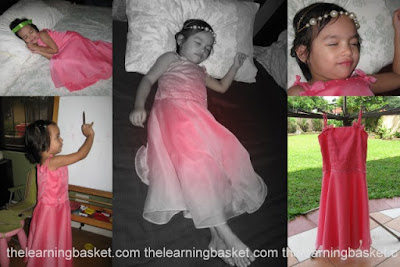
    Little T dressed up as Sleeping Beauty the whole day after
    watching the play. Her gown is a hand-me-down two times over.
    Playing pretend is one of the greatest joys of childhood. Nothing can be as magical as imagining yourself to be a princess, a bride, or a mermaid -- yes, my daughter is such a girl. Seemingly simple, pretend play actually works on several levels of a child's development: social, emotional, language, and cognitive.